RU
RU EN
EN CN
CN


Global annual consumption of paper bags exceeds 400 billion pieces. Spurred by worldwide plastic restriction regulations, water-based ink has become the dominant printing material for paper bag production thanks to outstanding eco-friendly properties. Even so, printing manufacturers are continuously plagued by six prominent technical drawbacks: inefficient drying (residual moisture>0.8%), unstable chromatic aberration (ΔE>1.5), insufficient ink adhesion (<3B), paper surface fuzzing, excessive ink bleeding (bleeding rate>15%) and printed surface whitening (whitening area>5%). These flaws push up scrap rates and may trigger food packaging compliance hazards for food-grade paper bag products.
Relying on 2024 full-scale production data and over 10 years of frontline printing R&D experience, this article elaborates systematic improvement approaches ranging from ink formulation reform, production parameter tuning to equipment upgrade, with standardized test figures and equipment selection guidance to help printing plants break through quality and productivity bottlenecks.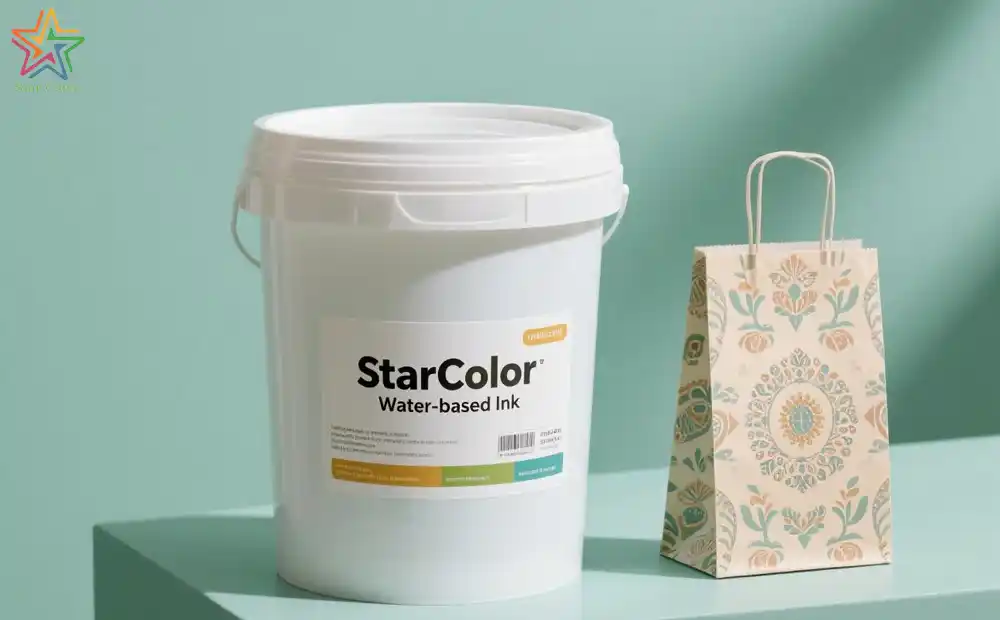
1. Inadequate Drying Capacity (Residual Moisture > 0.8%)
Core Pain Point: Conventional single-temperature drying tunnels running at 60–70°C fail to balance drying efficiency and paper deformation control. Uneven moisture evaporation leaves high residual water inside printed paper, leading to stacked sticking and paper wrinkling.
Targeted Optimization:
- Three-stage gradient temperature drying setup: Progressive heating at 50°C →75°C →95°C paired with redesigned air duct to build ±2m/s differential swirling airflow. Overall drying efficiency improves by 42% and residual moisture is controlled below 0.3% consistently.
- High-solid ink reformulation: Lift ink solid content from original 45–50% to 55–60%, incorporate 0.5% wax powder to modify surface tension and accelerate water volatilization; install high-precision infrared moisture tester (±0.05% accuracy) for real-time inline monitoring, shortening complete drying cycle down to 18 seconds.
2. Out-of-spec Printing Color Deviation (ΔE > 1.5)
Full closed-loop process control:
- Replace manual Zahn cup viscosity test with rotary viscometer to realize ±0.5s stable viscosity management, restricting color density fluctuation within ≤0.05.
- For base stock with Cobb value between 30–50g/m², apply 3–5g/m² primer pre-coating; utilize servo closed-loop impression pressure control (±0.8N/cm) to limit ink film thickness tolerance ≤0.1μm and dot gain ≤12%.
3. Poor Ink Adhesion Rating (<3B by ASTM D3359 Cross-cut Test)
Multi-path adhesion promotion solutions:
- Surface corona activation: Operate corona equipment at 1.5–2.5kW with line speed capped at 150m/min to raise paper dyne value ≥42mN/m, lifting adhesion grade up to 4B.
- Silane chemical coupling modification: Add 0.3–0.5% KH-550 silane coupling agent, pre-disperse at 2000rpm for 30min, achieving 5B adhesion performance on coated and PET-laminated paper substrates.
- Nano silica reinforcement: Compound 8% 20nm SiO₂ nanoparticles with 15min ultrasonic dispersion; finalized ink delivers 300% higher rub resistance, verified via ASTM D3359 cross-cut test & 3M 600 tape peel inspection.
4. Paper Surface Linting & Dusting
Precision parameter & raw material control:
- Select base paper complying with ISO 8791-4 standard: surface roughness Ra ≤3.5μm and calcium carbonate filler ≤18%, or shift to clay-coated stock for upgraded surface compactness.
- Limit printing linear pressure ≤120N/cm, adopt 180LPI anilox roller; emergency improvement: supplement 2% BYK-348 leveling additive into finished ink to reduce surface pull-out.
5. Excessive Ink Bleeding (Bleeding Rate >15%)
Three-tier preventive system:
- Paper upgrade: Specify base paper ≥80gsm with sizing degree ≥50s per GB/T 460, cutting bleeding ratio by 60% inherently.
- Ink thickening modification: Boost solid content to 55% and introduce 0.5% colloidal silica; upgrade anilox roller line count (e.g. shift from 200LPI to 300LPI), bringing bleeding rate down below 10%.
- Pressure fine-tuning: Equip air-cushioned impression cylinder to lower linear load to 80–100N/cm, deploy Techkon SpectroDrive inline bleeding monitoring module for real-time data tracking.
6. Printed Pattern Whitening (Whitened Area >5%)
Classified troubleshooting against different whitening root causes:
- Condensation-induced whitening: Install workshop constant humidity system to stabilize ambient RH at 55%±5%, fully eliminate condensation whitening issue.
- Ink emulsification whitening: Adjust ink pH value to 9.0–9.5 via ammonia regulation to recover ink transparency and avoid abnormal emulsification.
- Resin precipitation whitening: Preheat bulk ink to constant 25°C±1°C to optimize fluidity to Grade 4 and resolve low-temperature resin precipitation defects.
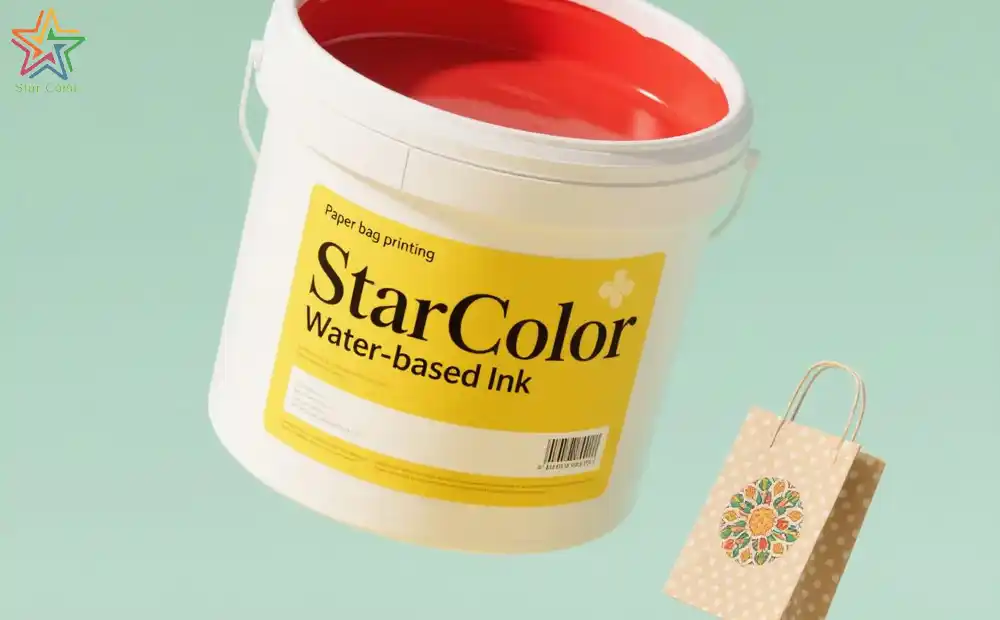
Core Advantages of StarColor Water-based Flexo Ink for Paper Bag Printing
Validated across dozens of printing plants, above process plus StarColor proprietary ink formulation drastically boosts production yield and finished quality. As benchmark flexo water-based ink brand from Zhongzhixing, StarColor brings distinctive benefits for converters:
- High-speed adaptability: Compatible with high-speed flexo presses up to 450m/min. Matched with three-stage gradient drying, drying period shortens to 18s and production throughput rises by 42%.
- Stable batch consistency: Formulation locked at viscosity 20±5s & pH 8.5–9.0; color density fluctuation ≤0.05 and batch-to-batch color difference ΔE controlled within 0.7 for sharp dot reproduction under high running speed.
- Global food safety compliance: FDA food-contact approved, VOC as low as 1%, fully compliant with China GB 4806.14-2023 standard; low-odor non-irritant formula ideal for food-safe paper bag applications.
- Remarkable economic return: Ink consumption reduces by 40% compared with conventional solvent-based ink. Mid-size printing factories can save around USD 137,000 annually on raw ink procurement; solvent-free wash procedures cut equipment maintenance expenditure by 30% year-on-year.